Category: Hospitality

  • Bar Organizational Structure and Their respective Duties

    Bar Organizational Structure and Their respective Duties

    Bar organizational structure and charts – For some people, being able to work in a bar is a fun job.

    Being able to serve drinks to relieve guests’ fatigue is an interesting thing to do.

    Moreover, guests are satisfied with the drinks served, it is not impossible that we can get some tipping sheets. Yes, right?

    Of course, the team in a bar consists of several people who have their respective duties and functions according to their positions.

    The number of teams usually depends on the scale of the hotel/restaurant where the bar is located.

    Bar Organizational structure Chart in the Small to Mid-Scale bar
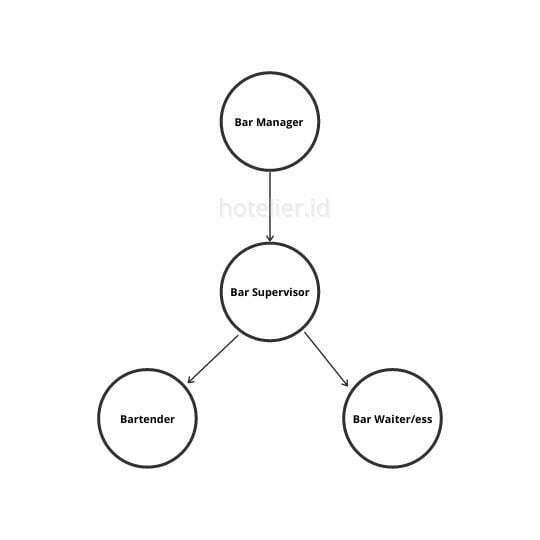
    Bar Organizational Structure and Their respective Duties
    Bar Organizational Structure chart

    Task Bar Manager

    According to its function, a leader or manager is of course the main task of carrying out management functions such as planning, organizing, executing, and controlling related to bars such as:

    • Create a bar sales strategy to achieve the target given by the company
    • Make sales report every month
    • Ensure that bar operations are running according to the SOP
    • Check the log book, if there is any important information or message
    • Validate the requisition list for stock beverages, perishables, groceries, etc.
    • Deliver beverage sales, attendance, and requisition lists to the F & B Manager for the validation process including transferred and broken reports and so on.
    • Check the stock of peanuts, criping, and beverage stock. If supplies run low, you must immediately submit a warehouse request (This is usually assisted by the Bartender because he is the one who directly uses it to serve guests.)
    • Checking the cleanliness and tidiness of the room, as well as the cleanliness and tidiness of the subordinates (personal appearance).
    • Checking other preparations used in the operation, such as cleanliness and completeness and sufficient quantity of each item.
    • Check the cleanliness and completeness of the bars in several outlets.
    • Hold briefings with all staff.
    • Every week accompanying Cost Control to conduct an inventory.
    • Appraisal staff every 6 months
    • Report problems that occur to FBM

    Also read: What is Sparkling Wine and How to Make It at Home

    When the bar is operating:

    • Supervise the running of services and operations in accordance with the company’s overall SOP
    • Help welcome guests who come.
    • The Bar Manager must be able to provide motivation and work encouragement to subordinates and maintain good relations with other departments.

    Bar Captain/Supervisor Duties

    Of course, the supervisor is the second hand of a manager. So when the manager is not in the area, the bar supervisor is responsible for the smooth running of all activities in the bar team. In general, the task of the supervisor bar

    • Make a monthly work schedule for all team bars
    • Assign tasks to Bartenders to outlets.
    • Provide briefing, briefing and training, both to all teams at the bar
    • Order the bartender or bar waiter/ess to do side duties.
    • Check stock of beverages, garnishes, peanuts and so on.
    • Checking the drink list, the neatness of the tables and chairs and the preparations that have been done by the bartender and bar waiter/ess
    • Accommodate and resolve issues facing bartenders and water/ess bars.

    When the Bar is operating:

    • Welcoming guests in a friendly and courteous manner, delivering and finding suitable seats.
    • Offer/suggest and take drink orders from guests
    • Always maintain smooth service.
    • Busy helping the bartender make cocktails and
    • helping the Bar Waiter serve drinks to guests; etc

    When the bar closes

    • Conduct an evaluation of previous performance
    • Record sales results and make reports.
    • Provide briefing if needed
    • When going home, check whether the condition of the room is clean and tidy, the doors are locked, and so on.

    Bartender’s Duty

    As we know the bartender is someone who is in charge of making, concocting and dispensing drinks.

    In addition, here are the duties of a bartender:

    • Clean the bar area, especially the parts that have not been cleaned by housekeeping.
    • Wipe tables, chairs, counters, and drink bottles.
    • Take various drinks, groceries, and perishables from
    • the warehouse to replace goods that have been sold or to increase stock at the time of peak hour
    • Taking goods/supplies whose inventory is less than
    • stewards, such as muddler, coaster, olive-pick, paper napkin, straw, and glasses.
    • Prepare welcome drinks for guests who check in that day, whether for VIP guests, regular guests, group guests, or guests who come individually.
    • Prepare fresh lime juice for cocktail mix or sliced ​​lemon for garnishes and so on.
    • Prepare and arrange tools for the operation, including shaker, jigger, cocktail strainer, funnel, bar knife, can opener, corkscrew, bottle opener, ice spoon, ice tongs, wine basket, and so on
    • Prepare condiments such as tabasco and lea & Perrins sauce syrup, angostura bitter, fresh eggs, and so on, including cherry, olive, salt & pepper (salt and pepper)
    • Provide potato chips, cassava chips, peanuts, and so on
    • Prepare beer, soft drinks, and white wine in a cold place in sufficient quantities

    When the bar is operating

    • Make cocktail orders for guests according to standard recipes and sizes that have been set.
    • Always keep the workplace neat and clean.
    • Always neat in appearance, polite, friendly and maintain good relations with guests and so on.

    When the bar closes

    • Storing tools in their original place after cleaning, and drying thoroughly
    • Collect empty bottles and store them at the appointed time
    • Rearrange drink bottles in storage
    • Tidy and clean the counters of food houses to avoid the danger of rats or other insects,
    • Reporting to the Bar Supervisor if there are problems with operating time.

    Bar waiter/ess duties

    • Together cleaning and maintaining the cleanliness of the bar room, counters, tables, chairs, and so on.
    • Helping the Bartender take various drinks from the warehouse, perishables (lemon, eggs), groceries items such as juices, peanuts, potato & cassava chips, condiments, syrup, sugar, and so on.
    • Bar table set up with cocktail paper napkins that have been folded and neatly arranged in paper napkin stands, ashtrays, drink lists, tend cards, and flower vases
    • Help the Bartender prepare clean glasses, potato chips, peanuts, and so on.
    • Arranging the location of the tables and chairs, and so on.

    When the bar is operating

    • Welcoming guests in a friendly and courteous manner
    • Invite guests to sit
    • Taking drink orders from guests
    • Serve drinks that have been made and prepared by the Bartender to guests in a friendly, flexible, and polite manner.
    • Appear neat, and clean, and always maintain a good relationship with guests.

    When the bar closes

    • Together with other teams clean and tidy up the table layout and other equipment
    • Collecting dirty glasses and bottles
    • Inform the FB Supervisor if there are obstacles regarding performance on that day.

    That is the general organizational structure of the bar and their respective duties.

    Reference: Bars, Drinks, and Their Services – H. Marsum Widjojo Atmodjo, SE

  • 40 Hotel Room Status and Description [Complete]

    40 Hotel Room Status and Description [Complete]

    Hotel Room Status -Many people say that working in a hotel is good, isn’t it? Wear a suit, tie, handle important people and the service charge is high.

    Indeed, such a mindset is still inherent in the minds of the general public. In fact, when directly involved in the world of hospitality, it is not as beautiful as the image. 

    Just like working in other industries, there are many things that we must learn and understand before going into the field.

    Starting from the system, work culture, and especially in hotels, the most important thing for us to know at the beginning is the status of the rooms.

    This is very important because the status of this room will be related to what actions will be taken against the room.

    40 Complete Hotel Room Status

    Hotel room status is a sign that is used to make it easier for the operational team to identify what actions should be applied to that room.

    Also read: Upselling Tips for Front Office Hotel Teams

    The status of this room will appear in the property management system (PMS) and can be seen by all teams in the hotel.

    The following are some of the common room statuses we encounter when we are on duty in hotels. For those of you who are just learning about hospitality, you can note this:

    1. Vacant Clean

    The room is empty and clean

    2. Vacant Dirty

    The room is empty but still dirty

    3. Vacant Ready

    The room is clean and ready for sale

    4. Occupied Clean

    The room has been filled with guests and has been cleaned by the room attendant

    5. Occupied Dirty

    The room has been filled with guests but the room attendant team has not cleaned it

    6. DND (Do Not Disturb)

    Guests in the room do not want to be disturbed

    7. OOS (Out of Service)

    Room under repair

    8. OOO (Out of Order)

    Rooms are under repair and usually last a long time. Damage may occur quite seriously for this room and takes a long time. In OO conditions it will usually reduce availability

    9. EA (Expected Arrival)

    List the names of guests who will check in and already contains the room number

    10. ED (Expected Departure)

    List the names of guests who will check out on that day

    11. Check-in (C/I)

    Guests who have arrived at the hotel and complete all administration before entering the room

    12. Check Out (C/O)

    Guests who have paid all payments and have left the hotel

    13. DU (Day Use)

    Guests who check-in in one room but will check out on the same day before the night audit is run

    14. SO (Sleepout)

    Guests who have booked a room but don’t sleep in the room

    15. COMP (Compliment)

    Guests who stay but are not charged a room fee (Free). These are usually guests from the media for marketing needs, guests from the hotel owner or the owner’s family.

    16. WIG (Walk in guest)

    Rooms are occupied by guests who come directly to the hotel and book on the same day. In other words without making a reservation in advance.

    17. VIP (Very Important Person)

    This means that this room is filled by someone who is quite important or a public figure. For example Officials, Artists, and others.

    Special services are also needed to handle guests in rooms with a VIP sign.

    18. HU (House Use)

    The room occupied by hotel staff

    19. Stay Over

    The guest has decided not to check out and will stay at least one night.

    20. Cleaning in Progress

    The room Attendant is in the process of cleaning the room.

    21. Sleep Out

    The next hotel room status is Sleep Out. This means that hotel guests who have booked rooms and completed administration do not sleep in their rooms.

    22. On Queue

    The guest has arrived at the hotel, but the room provided is not ready. In such cases, rooms are placed on Queue status for housekeeping staff to prioritize those rooms first.

    23. Skipper

    The guest has left the hotel without making arrangements to settle his account.

    24. LO Lockout

    The room has been locked so that the guest cannot re-enter until he or she is cleaned by the hotel staff.

    25. DNCO – Didn’t Check Out

    The guest made arrangements to pay the bill (and thus excludes the skipper), but instead he left without notifying the Front Office.

    26. DO Due Out

    Rooms are expected to be vacant after the following guest checks out.

    27. LC – Late Checkout

    The guest has requested and is permitted to check out later than the hotel’s normal/standard check-out time.

    28. EC – Early Checkin

    The guest has requested Early Check-in and is permitted to check-in earlier than the hotel’s normal/standard check-in time.

    29. V/C or O/V – Status Unclear

    (Whether the room is vacant and clean or occupied or vacant) needs to be verified by Housekeeping staff.

    30. VCI – Vacant, Cleaned, and Inspected

    Empty Room, Cleaned and Checked by Housekeeping Supervisor.

    31. H/L – Heavy Luggage

    Guests bring luggage that is heavier than normal.

    32. L/L – Light Luggage

    Guest with very light built-in onions.

    33. N/L – No Luggage

    Guests come with no luggage.

    34. DL – Double Lock

    The guest has put a double lock in the room.

    35. CL – Chain Lock

    Guests install chain locks in hotel rooms.

    36. NCI – Newly Checked In

    The room has been checked within the last 1-2 hours.

    37. NS – No Show

    Guests who make room reservations but do not register or check in.

    38. SR – Service Refused

    The guest refuses to have the room cleaned.

    39. V – Vacant

    Empty

    40. MUR – Make-Up Room

    Doing guest room cleaning work after guests check out, then they have cleaned again so that guests who have just come to stay again can rest in peace, comfort, and safety.

    41. PMR – Please Make up Room

    That is, the guest asks for the room to be cleaned

    Those are some of the statuses of hotel rooms that are generally used in a hotel.

    Of course, by knowing these terms, housekeeping and the front office will find it easier to work together and communicate effectively.

  • Upselling Tips for Front Office Hotel Teams

    Upselling Tips for Front Office Hotel Teams

    Upselling is one of the sales strategies commonly used to increase revenue by offering products that are more expensive than the products that consumers want to buy.

    No exception in hotels, upselling is usually carried out when new guests arrive at the hotel to check in by offering more expensive rooms or other activities that guests have the opportunity to buy.

    Usually, there is an incentive program for reservations and the reception team offered by hotel management helps motivate staff to make this up-selling program run well.

    Definition of Upselling

    Upselling is often said to be one of the arts of selling.

    The upselling technique is a strategy that can be understood as a selling technique to persuade customers so that they want to spend more money.

    Also read: Sequence of Service Restaurant: Definition and Procedure for Implementation

    So that customers buy products of the same type at a higher price. Or products with additional advantages such as additional bonuses or guarantees of better quality/details.

    In up-selling sales techniques, we are not required to know the customer to find out his needs.

    ut in the up selling technique, we are required to master the advantages of one product in order to offer it to customers.

    For example, if a customer has booked a deluxe room, then we can offer to upgrade to a suite, for example.

    Of course, we have to explain the benefits that customers get when upgrading the room.

    In this example, we are driving customers to spend more money on the products they buy.

    Example of SOP Upselling at a Hotel

    The upselling concept is a method implemented with the aim of providing benefits to guests, employees, and management so that they can motivate employees as the spearhead of this up-selling program.

    Besides that, training programs need to be implemented, so that employees really understand and are able to carry out standard operating procedures to do up-sells.

    This situation will help avoid protests from prospected guests, and time is spent more effectively. The following is an example of an upselling SOP that can be used as a reference:

    • Always greet every guest with a smile in your voice and face.
    • Always Establish and maintain eye contact with guests.
    • Ask open-ended questions to understand guest needs and requirements, provide timely advice and offer alternatives by upselling.
    • Understand guest profiles from reservation details and identify guests who are most likely to occupy higher category rooms.
    • Bookings made through the company or negotiated rates or by the sales team will most likely not take higher category rooms and therefore their bill is usually paid by their company.
    • Honeymooners, family vacation trips, long stays, online travel agents (OTA), direct bookings, direct arrivals, etc. Most likely will choose the upsell offer. This is because in most cases guests who come to stay at the hotel do not know the different rooms offered by the hotel.
    • Be fun and like a business, because you are selling yourself as much as you are selling hotel amenities and services.
    • Find out the guest’s name right away and use it at least three times during the conversation.
    • Always use appropriate titles such as Mr, Miss, Mr, and Mrs when greeting guests and never call guests by their first names, always use last names with appropriate titles.
    • Attempt to identify guest needs as these needs may not have been identified during the reservation process.
    • Customize guest needs with room furnishings or amenities or views (ocean view, pool view, mountain view), etc.
    • If a guest stays several nights then he will be attracted to a larger or more spacious room.
    • If guests are on their honeymoon, offer rooms with views such as sea facing, pool facing, mountain facing rooms, etc.
    • If a guest has a reservation in a lower category, state the main differences and additional features they get when compared to a higher category room.
    • Inform about additional fees or rate differences with encouraging statements such as for X amount difference you can get a room with a sea view.
    • Upsell the room by showing the features and benefits first, then mention the price difference.
    • If there are two different types of rooms available, state the advantages of the two rooms so that guests can choose the best one that suits their needs
    • For walk-ins always provide details of a lower category and higher category to avoid the risk of losing revenue when trying to upsell to guests.
    • Always thank guests after a successful upsell.

    The up-selling program is a program that is very possible to run because the majority of guests do not know and recognize hotel products, so they often order rooms or other standard hotel products, which do not match their needs and desires.

    This opportunity needs to be used by management to increase hotel income. It’s easy? Let’s practice!

  • What is Sparkling Wine and How to Make It

    What is Sparkling Wine and How to Make It

    What is Sparkling Wine? Yes, sparkling wine is a natural still wine that contains carbon dioxide. That’s why it has soda bubbles when it’s poured.

    The wine is sold in bottles of inches of various sizes and colors and contains 14% alcohol.

    Usually, the cork (bottle cap) is tightened and strengthened with a wire covered with silver foil to prevent the cork from falling off due to pressure and carbon dioxide.

    How to make Sparkling Wine

    What is sparkling wine

    In the process of making sparkling wine, there are two methods that can be done. The two methods are:

    1. Impregnation Method

    In this method, carbon dioxide gas is injected into the wine bottle individually and then in the cork cap.

    2. Champenoise Method

    Now if this method is used to make champagne by adding sugar and yeast to the wine to create a second fermentation in the bottle.

    Also read: Sequence of Service Restaurant: Definition and Procedure for Implementation

    Types of Sparkling Wine

    In general, sparkling wine has white and pink colors, but there are also red sparkling wines.

    There are 2 types of sparkling wine, namely:

    1. Champagne

    This wine is made in the Champagne region of France using the Champenoise method.

    Champagne is categorized as the best sparkling wine with the nickname The King of Wine so wine quality standards are used.

    Champagne Example:

    • Moet & Chandon Dom Perignon
    • Charles Heidsick
    • Mum Gordon Rougue
    • Runiart Dom Runinart

    2. Others Sparkling Wine

    This type of wine is usually made by both methods, either impregnation or champenoise. Generally produced in France, Germany, Italy, and Australia.

    Example:

    • Red Sparkling Burgundy (France)
    • Asti Spumante (Italy)
    • Casino Sect (Germany)
    • Borrosa Pearl (Australia)

    Sparkling Wine Bottle Type and Size

    Sparkling wine is usually sold in bottles of various types and sizes.

    Example:

    • Split contains 20 cl of wine
    • Half Bottle contains 40 cl of wine
    • Imperial Pint contains 60 cl of wine
    • Full Bottle contains 80 cl of wine
    • Magnum contains 160 cl of wine
    • Jero Boam contains 320 cl of wine

    How to Serve and Store Sparkling Wine

    Sparkling should be stored properly at a temperature of about 10 degrees Celsius in a horizontal condition.

    And best when served cold between 7-10 degrees Celsius.

    So a wine cooler is needed for this.

    Sparkling wine and food to match

    Sparkling wine can be drunk as a companion to various types of food. So in other words, sparkling wine goes well with all types of food.

    For example:

    • Brut with fish and oyster
    • Extra dry goes well with shells, fishes, lobsters
    • Sec goes well with caviar, smoked salmon, white meat and red meat
    • Demi sec, matches pates , fruits
    • Demidoux and doux go well with sweet foods like puddings, pastries etc.

    So you’re not curious anymore, what is sparkling wine?

  • Sequence of Service Restaurant: Definition and Procedure for Implementation

    Sequence of Service Restaurant: Definition and Procedure for Implementation

    Sequence of service is the order or procedure in which a waiter/ess provides services to guests.

    Starting from the moment the guest enters the restaurant until he leaves the restaurant. This stage aims to provide the best service to every guest who comes.

    This procedure is the most basic thing that you must know for those of you who want to enter the restaurant world, especially the waiter server section/waitress server section.

    Then what is the order of this sequence of service?

    Example of a conversation when welcoming guests in the sequence of service:

    • Waiter: Good morning welcome to (please state the name of the restaurant). How are you this morning sir/madam?
    • Guest: I’m Good, Thank you
    • Waiter: My name is Agus, How may I assist you?
    • Guest: Yes, I want to have breakfast
    • Waiter: Certainly sir/madam. Do you have any reservations in advance
    • Guest: No.
    • Waiter: May I have your name sir? and how many people will be?
    • Guest: My name is Peter. for 3 persons
    • Waiter: You want a smoking area or nonsmoking area Mr. Peter?
    • Guest: Not smoking area, please!
    • Waiter: alright Mr.Peter let me escort you to your table, could you follow me, please?
    • Waiter: Ok Mr. Peter this is our restaurant, we have many tables here, on the left corner facing the view and on the right corner facing the bar, which one would you like you seat Mr. Peter?
    • Guest: On the right corner, please!
    • Waiter: Could you follow me, please?

    Also read: A La Carte: Definition, Menu Examples, Characteristics, and Advantages

    Waiter/ess Invites Guests to Sit / Seating The Guest

    • Slowly pull the chair, prioritize women to be invited to sit but prioritize older guests
    • Offer to use the baby chair if there are small children
    • Offer assistance to guests carrying heavy items
    • Help guests who are wearing coats to open and put them on the back of the chair
    • Tell the number of guests to the server

    Example of conversation when seating the guest:

    • Waiter: Mr. Peter this is your table, is it ok for you?
    • Guest: Cool, thank you.
    • Waiter: Have a seat, please!

    Providing Condiments / Preparing of Condiments

    • Unfold napkin
    • Stand to the right of the guest.
    • Unfold the napkin according to standard procedures
    • Place the napkin on the guest’s lap carefully so that the guest doesn’t feel disturbed

    Pouring The Water

    • The regular running water should be clean with enough water for the number of people at the table.
    • Must be cold and room temperature according to guest needs.
    • Should be carried in the underliner or with a neatly folded waiter/ess cloth to ensure thick water does not drip on the table.
    • Water should be served from the right side, women should be served first.
    • Mineral water poured from Seal bottles must be opened in front of guests.

    Giving Menu List / Giving The Menu

    The Sequence of Service is
    • Take a list of drinks and food menus from the station
    • Make sure the menu is clean and in good condition
    • Give from the guest’s right and in an open state
    • Women first
    • Give 5-7 minutes of time for guests to see the menu before being asked to order
    • Stand perfectly, keep smiling and make eye contact
    • Slowly explain today’s menu by saying something like this: Excuse me madam/sir, I would like to explain about the menu for this morning…for the appetizer…..for the main course….and finally for the dessert…

    Drink Order / Beverages Taking Order

    • Inform about special food and drinks or those that are being promoted
    • Prepare the captain order and pen
    • Write all orders on the captain order clearly and completely
    • Write table number, order name, date, time, number of guests, item, order quantity and size, and any special requests from guests if any.
    • Tell all food and beverage information that is sold clearly and accurately to guests according to guest needs

    Deliver Orders From Kitchen / Bring The Food From Kitchen

    • Before the ordered food comes to the guest table, prepare the equipment needed to serve food in accordance with existing standard operating procedures
    • Double check the good condition in terms of cleanliness and quality of the food, the accompanying seasoning or sauce, as well as the size and quantity of the food ordered.

    Serving Food / Food Serving

    The Sequence of Service is
    • Check whether the food that will be served is in accordance with the captain’s order so that it doesn’t go wrong with the intended table, size, and amount
    • Serve food from the guest’s right or from the easier side
    • Be careful if there are small children.
    • Say the word “excuse me ma’am/sir” slowly and clearly
    • Pay attention to the layout of the food on the lazy susan, and make sure the garnishes are facing in the right position.
    • Don’t forget to mention the name of the food
    • Check the list of foods that have been served
    • Stay on stand-by at the charge table and make sure guests’ needs are met
    • Always check if there are empty and dirty plates, those with food residues that exceed 2 pieces must be replaced immediately
    • Don’t pile dirty dishes too high
    • Pile up similar plates without food residue on them
    • Confirm to guests when all orders have been served
    • Offer back if there is additional food and ask if there is a shortage in the order
    • Act immediately if there is an error or complaint

    Offer Dessert / Dessert Suggestions

    • Waiter/s offers a dessert menu to guests when the main course menu has finished eating
    • Put the toothpick on the table
    • Prepare the equipment needed to serve dessert
    • Make sure the table is ready to serve dessert

    Changing the Ashtray / Change The Tray

    • Take a clean ashtray, place it on a dirty ashtray, then remove it and replace it with a clean ashtray
    • Use the tray to replace it
    • After 2 cigarette butts, the ashtray must be replaced immediately

    Deliver Bill / Settle Bill

    • Check the bill from the excel cashier application to whether it is in accordance with the order
    • Use a cover bill and prepare a pen
    • Give from the guest’s right with his right hand and in an open state
    • Ask guests how they feel about the service and food that has been served
    • Give and inform if special promos, events, and or discounts are currently in effect, explain briefly, clearly, and interestingly so that guests are interested to know about it and come back.
    • Wait a moment for payment
    • Recalculate the amount of money in front of the guest if the guest pays in cash and make sure it matches the amount of the bill
    • Pay attention if there is a payment with a room charge, make sure the guest data supports payment through a change room
    • Don’t forget to return the change to the guest
    • Say thank you and keep smiling

    Say Thank You

    • Make eye contact, smile, with a slight bow when saying thank you
    • Guide guests to the door with a few short, friendly, and memorable conversations to keep guests coming back.

    Those are the stages of the sequence of service that are generally applied in restaurants. May be useful.

  • A La Carte: Definition, Menu Examples, Characteristics, and Advantages

    A La Carte: Definition, Menu Examples, Characteristics, and Advantages

    A la carte is the term for the system of serving dishes in star restaurants and upscale hotels.

    Maybe some of you have seen this term in fast food restaurants and you must be wondering, why do fast food restaurants also have an a la carte menu? Actually, what is the meaning of this term?

    Here’s the explanation:

    Let’s see the following explanation so that you better understand the term a la carte.

    What is A La Carte? (Definition)

    Ala carte is a French expression that means “according to the card ” in English.

    The meaning of the word refers to the menu of food available in the restaurant. All menus include:

    • Appetizer
    • Main Course
    • Dessert

    Restaurant visitors can freely choose what type of food they want from the menu in a restaurant according to their food tastes and pay for the menu they choose

    This term is a revolution of the restaurant system that occurred in the 19th century.

    At that time, each restaurant would only offer a  table d’hôte system meaning diners could only enjoy their pre-set meals.

    This menu is then served to all visitors who want to take part. With no other choice but the dish that is already in front of the visitor.

    Judging from the table d’hôte dish system it is very inefficient and leaves a lot of leftover food wasted.

    Finally came the a la carte system that provides various types of food that visitors can order according to their appetite.

    Also read: Gueridon Service: Definition, Types, Advantages, and Disadvantages

    Characteristics of A La Carte

    1. This menu has more variety than the table d’hôte menu which has more places to prepare food than the a la carte menu.
    2. Offers a wide selection of food and beverages by type and category.
    3. Each item on the menu has a small narration below its food menu to explain the type of dish.
    4. The chef will cook the dish after receiving the food order from the waiter. So this food can be served well and still warm.
    5. Each meal has a different preparation time.
    6. Food prices are much more expensive than table d’hôte menus and require more space and kitchen equipment.
    7. Usually, these dishes offer varied and expensive seasonal dishes.
    8. All appetizers, dishes, salads and desserts can be ordered separately by customers
    9. Dishes that often use this system are found in almost all types of food and beverage businesses. Except for banquets, flight catering, institutional catering, and other meeting catering.

    Because it has a large selection of food and drinks, sometimes restaurant management can’t know the increase in orders from each food.

    This makes it difficult for the restaurant industry to control raw material supplies and ensures that much fewer leftovers are made than table d’hôte menus.

    Here are the food menu styles that you should know:

    A La Carte and Semi A La Carte Menu Style

    1. Breakfast Menu 

    Almost all of the breakfast menu comes from both a la carte and all a la carte segments.

    Examples of a la carte menus on the breakfast menu offer juices, fruit, cereals, eggs, meats, pancakes, French toast, waffles, bread, side dishes, and drinks. Meanwhile, the semi-segment usually offers a combination of food variants.

    Usually, the breakfast menu has the following characteristics:

    • Although breakfast menus are offered in many upscale restaurants and large hotels, they are usually more expensive. Even so, the breakfast menu offers food at a reasonable price.
    • Some breakfast dishes will be prepared after the order has been made.
    • The breakfast menu usually has a reliable chef to provide food quickly.
    • American-style service usually has a waiter take orders and serve them to the guest table.

    Example of A La Carte Breakfast Menu Menu :

    • Juice,
    • Fruit,
    • Cereals,
    • omelet,
    • Waffles.
    1. Luncheon Menu
    A La Carte Is

    Unlike the breakfast menu, the lunch menu usually offers a la carte and semi a la carte dishes.

    In this lunch section, the dishes they usually offer are appetizers, salads, sandwiches, entrees, desserts, and drinks.

    As for the spring menu, it is an appetizer with salad, vegetables, potatoes, or rice. Here are the characteristics that you can find in the lunch menu:

    • The lunch menu usually offers special dishes.
    • The portion of the lunch menu dish is smaller.
    • Prices listed on the lunch menu may vary depending on the type of food, the operating system of the hotel or restaurant, and the location of the hotel or restaurant.
    • Requires proper kitchen equipment because usually, this lunch menu has many different cooking methods. Such as bread, baked, fried, and others.

    Example of A La Carte Lunch Menu Menu :

    • Sandwich,
    • Pasta,
    • Soup,
    • Salad.
    1. Dinner Menu

    The dinner menu includes a la carte and semi a la carte dishes. Usually, the dinner menu provides more appetizers than the lunch menu. Countries that often follow this system are America, France, and Russia.

    Example of A La Carte Dinner Menu :

    • Steak,
    • Short Ribs,
    • Lasagne,
    • Crab Cakes.
    1. California Menu

    Usually, this menu can only be found in California restaurants that only provide dishes based on time, whether it’s breakfast, lunch, or dinner.

    1. Ethnic Menu

    Furthermore, there is an ethnic menu that offers semi-a la carte or a la carte dishes.

    This menu provides dishes derived from traditional foods from certain regions or countries. The price range they offer tends to be more expensive.

    Advantages and Disadvantages of A La Carte

    Deficiency

    1. Slow Service

    This system is not very suitable for restaurants that have busy visitors. The more customers who order the a la carte menu, the slower the restaurant service to fulfill their customers’ orders.

    As a result, your restaurant will get complaints and complaints from visitors, of course, this can damage the reputation of the restaurant.

    1. Professional Team

    Because it provides many types of food, this system forces the staff to work faster.

    Starting from serving orders, delivering dishes, cooking processes, and others. Of course, this kind of service can only be done by a team of experienced waiters and chefs.

    Advantages

    1. Serving Customers Well

    One of the advantages or advantages of this system is that it offers good service to customers, from customers arriving, ordering food, to leave the restaurant.

    Customers can experience special service starting from choosing a seat, choosing a dish, delivering food, and professional waiters who can provide answers and best dish recommendations for all customer questions.

    This service is what makes customers feel special. Of course, this service system is impossible for them to get when visiting fast food restaurants or all-you-can-eat restaurants.

    1. Gaining Customer Loyalty

    Having loyal customers is an award for every business industry. For restaurants, one way to win the heart of a customer is to treat them well.

    Of course, this system is the best way and trick to win customers’ hearts and create a special taste and customer satisfaction from restaurant service.

    Table Setting Standard

    Almost all types of restaurants and hotels have unit menus like this system, ranging from casual places to fine dining places with luxurious white tablecloths.

    In addition to the menu, they also pay attention to the table setting so that the restaurant’s exterior looks more luxurious.

    Actually, this table setting aims so that the waiter or waitress can arrange the place for each guest’s dish to be more organized and orderly when serving food.

    However, this standard of table setting is an obligation that must be carried out by every high-end restaurant.

    This table-setting system applies in every type of restaurant and hotel business.

    In addition, by implementing this system, visitors can rate the restaurant business services much better, so they believe in the quality of the dishes and restaurant service they will receive commensurate with the price they pay.

    Here’s how to create a table setting:

    • Place the main plate in the center of the table in an open position,
    • Place the knife and fork around the main plate,
    • Place the companion plate about 5 to 6 inches to the left of the main plate, and place the companion knife on the top right and facing left,
    • Position the napkin in the center of the main plate,
    • Position the glass about 2-3 inches to the right and about 2-3 inches from the tip of the fork.
    Example of A La Carte Table Setting

    Sample A La Carte Menu

    To improve the quality of restaurant service, at least the restaurant has a menu book that displays the available food dishes based on the type of food and its category.

    The following is an example of a menu book as a reference so that you know what to include in the menu book.

    In addition to a complete menu of dishes, of course, you must have a charming and neat appearance of the menu book, so that customers can read it well.

    1. Sample Menu A La Carte Indonesian food

    In Indonesia itself, many have applied the concept of menu presentation with the concept of A la carte. Here is one of them.

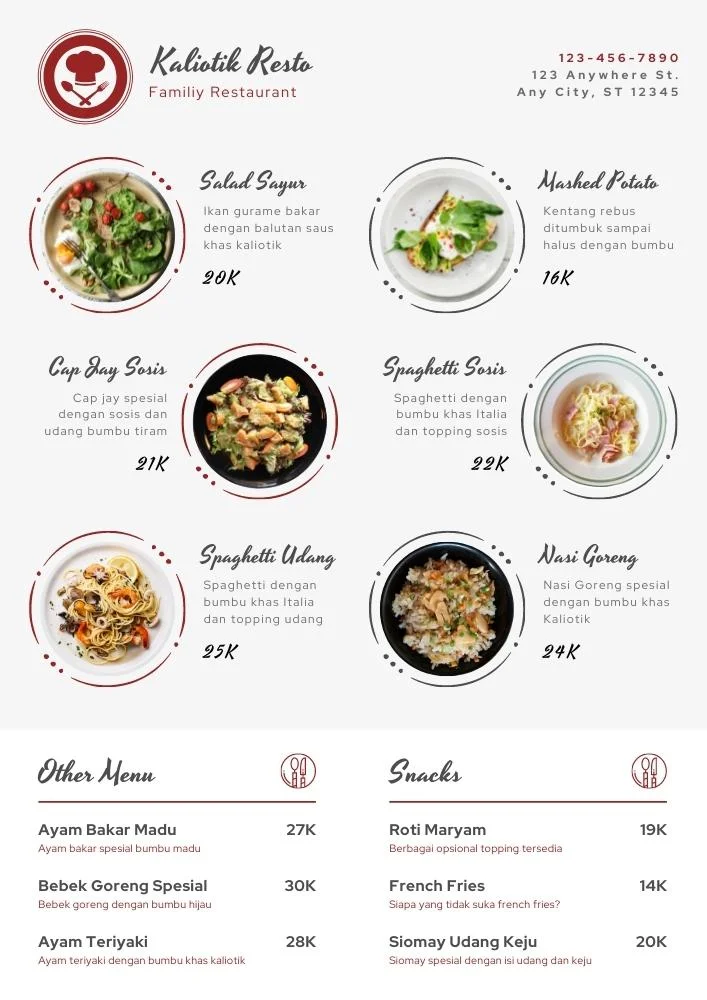
    Example of Indonesian A la Carte Menu
    Sample A la Carte menu

    2. Sample A La Carte Menu Overseas

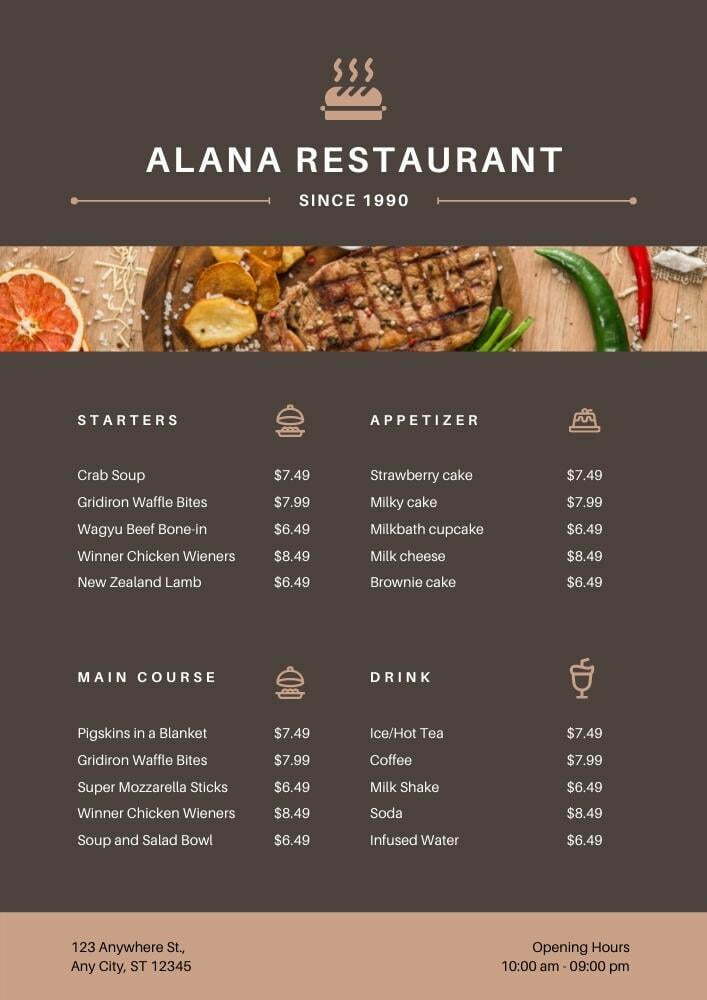
    More than 65% of restaurants in Europe apply the A La Carte menu concept. Here is one example.

    Sample A La Carte Menu

    Digital Menu

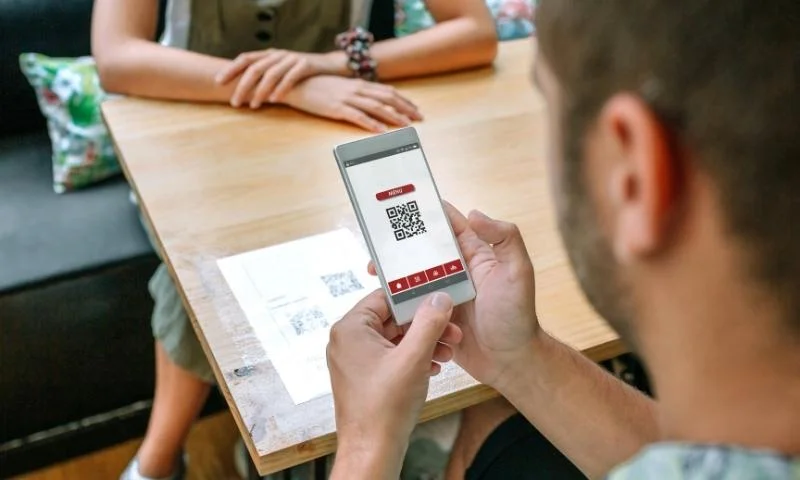
    The modern way to digitize the a la carte menu is to use a QR code. The things you must have before making this digital menu are food menus, food menu documents in PDF format or a website.

    This QR code is one of the most important features in any food business.

    Apart from being easy to access via smartphones, restaurants can minimize the spread of the virus between visitors and restaurant employees.

    You only need to create a QR code through an available online application and then print the QR code, insert it into a photo frame to make it look more beautiful, and place it in the middle of the dining table and around the restaurant.

    Besides being useful for displaying food menus, you can also use QR codes as a payment method easily.

    Scan QR Code Menu A La Carte

    However, as good as technology is, service is an important thing that a customer is looking for. There are some people who besides enjoying the food menu, they want to feel well served.

    Although digital technology has developed far, the service of waiters and waitresses is not replaced.

    Already Understand What is A la Carte?

    That’s the meaning of the term a la carte that you should know. Star hotels and high-end restaurants do use this system to better serve their customers.

    As for fast food restaurants, they only use this term in menu choices, not with special services that you can find and feel when visiting expensive restaurants.

  • Gueridon Service: Definition, Types, Advantages, and Disadvantages

    Gueridon Service: Definition, Types, Advantages, and Disadvantages

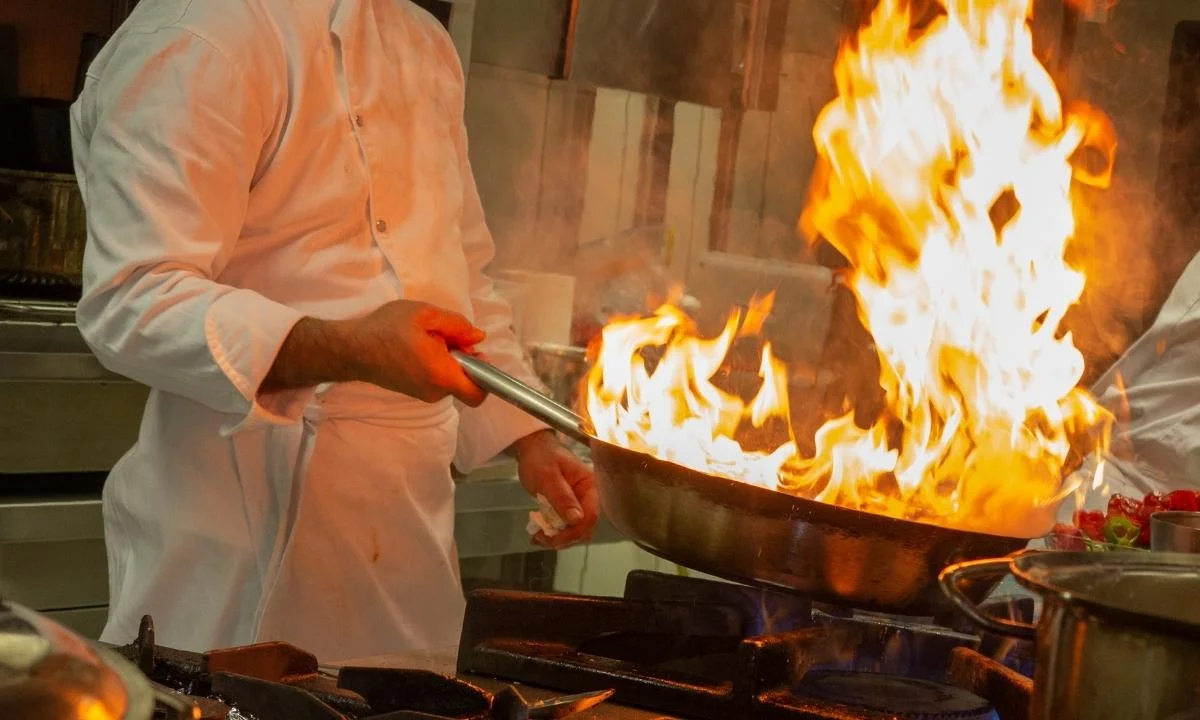
    Gueridon Service is a method of serving food by bringing a trolley or cart directly. So the presentation process can be done in front of guests.

    This method is widely used in some restaurants to add an exclusive impression. In addition, it will also add an interesting impression so that guests will get a dish of food in a condition that is still very fresh.

    The process of serving food in this way has its own advantages and disadvantages. So pay close attention to what can be obtained and can also be minimized so that guests continue to enjoy.

    Gueridon Service Definition

    Food serving varies from fine dining to serving directly to the table from guests. One type of presentation that is widely used today is the Gueridon service.

    Gueridon service is a method of serving food directly using a gueridon trolley. This trolley usually contains ready-to-eat or semi-finished food.

    Furthermore, the trolley can also contain a stove which will later be used to cook in front of the guests directly equipped with gas cylinders. But there are also those that are already in the form of ready-to-eat foods and are ready to be served.

    That’s why serving food in this way is quite popular in some restaurants. Because the process of serving the food will be done directly so that you can’t help but see how the chef’s abilities are.

    So someone can see firsthand how the food is served or how the cooking is done. If you have an attraction ability, the chef can show it as part of the show.

    Geridon Service Type

    Geridon Service Type

    Gueridon is a service whose service is determined by the type of food or how it is served. The following are some of the types of services that may be offered.

    1. Salad Serving

    Next there will be a salad serving that utilizes this method. As we all know, it is usually wrong to make it fresh and will be mixed directly with the dressing.

    If it has been mixed before when served, it may taste a little different. With this method of presentation, prayers will be served directly in front of guests so that the conditions are still really fresh.

    With this method, you can also determine for yourself how much food they will consume. So they don’t have to worry if it’s too much or too little.

    Also read: What is Hospitality? Complete Meaning and Scope of Work

    2. Fruit Serving

    Gueridon service is a service that always prioritizes the freshness of every food. That is why in every presentation the food is always brought directly and around to every consumer.

    That is why one of the types of food served is fruit which will be cut directly. The fruit will be cut and then given directly as a dessert.

    In addition, it can also be processed directly on the trolley such as juice or other beverages. So consumers can choose for themselves which fruit to consume and how much is needed.

    3. Serving Companion Meals

    Next is to serve various types of side dishes which will also be played later. What to eat later is usually quite a lot starting from bread, sauce, or something else.

    Usually some types of food will not be served directly or placed on the table. So if someone wants to use it or needs it, they can directly ask the waiters or cooks who brought it.

    This way the table will be very clean and contain only a few dishes and dishes that are really needed. With this method, the table cleaning process can run better because it is not too messy.

    4. Cooking Food

    Next up is the chef’s own cooking attraction using a trolley. Usually there are stoves and cooking utensils that can be pushed portable wherever consumers want them.

    Usually the food ingredients used are still in fresh condition so that guests can immediately wait and be served in a new condition. But for some materials also use semi-finished.

    When it will serve freshly cooked briefly and do not have to wait too long. Moreover, Gueridon service is a service that will make you more comfortable because everything is processed without any secrets at all.

    5. Adding Food

    The last service that will be provided when using this method is to add food that may have run out. This applies to restaurant services that apply an unlimited menu.

    In addition, it also imposes some additions on some foodstuffs for free. You can add soup or add other ingredients that are already rationed.

    So you can directly go around from one consumer to another. By using this service, one can get perfect service and will not feel lacking.

    The advantages of Gueridon Service

    There are several advantages of the Gueridon service that make it still liked by many people. Here are some of the advantages that can be obtained.

    • All food served with this method is fresh so it will increase the satisfaction of consumers who consume it.
    • Gueridon service is a personal service so everyone will feel very well served and cared for because everything depends on the request.
    • This service will provide convenience when delivering food directly to consumers.
    • Consumers can immediately give praise to the chef if they feel they enjoy the various types of trials that are given.
    • Make it easy for consumers to choose roughly what type of food they want, including the portion they want to consume.
    • Provide greater satisfaction to consumers so that the risk of being rejected by consumers is very small.

    Cons of Gueridon

    Although it has advantages, it turns out that there are also disadvantages that gueridon service has. Here are some drawbacks that may occur.

    • For chefs, sometimes pushing a trolley is quite inconvenient when carrying large amounts of food or cooking utensils.
    • It will be difficult to move from one place to another if you want to do a cooking demonstration in front of many people.
    • There is a possibility of an accident when cooking because the tools that are carried everywhere can be exposed to the hands.
    • In the event of an accident, consumers will also experience it because they will carry the stove anywhere, including hot cooking utensils.
    • Impossible to serve large quantities of food. But it can be done if the chef is assisted by several waiters.
    • It is likely that it will be difficult to carry out on-site preparations so a prior preparation process is required. So when in front of consumers just cook.
    • Don’t make mistakes when cooking in front of guests.

    Gueridon service is a fast-paced process of serving food. It can even do some kind of attraction so that guests will be more interested and willing to consume the food served.

    Unfortunately, there are still some risks that are obtained when using this method. One of the risks that may be obtained is an accident at work or it can cause other problems for guests.

  • What is Hospitality? Complete Meaning and Scope of Work

    What is Hospitality? Complete Meaning and Scope of Work

    What is hospitality? At first, glance when we hear hospitality, what comes to mind is a hospital. But the fact is, hospitality is not a hospital. Although these words are both taken from English.

    For those who have been in the world of hospitality, of course, this term is not foreign at all. Yes, it can’t be blamed either, because there is a lack of information about the hospitality industry.

    So what is the meaning of hospitality?

    Hospitality is an attitude or an act given by others. Or simply the relationship between guest and host, of which treatment and hospitality is the foundation.

    Is hospitality only limited to that? certainly not. Let’s look at the complete understanding of what hospitality is and the examples below.

    Definition of Hospitality

    If we open an English dictionary, then Hospitality means “hospitality”

    According to the Merriam-Webster dictionary, what is meant by hospitality has two meanings. That is:

    1. Hospitable: Treatment, Welcoming, and Behavior.
    2. Activities or businesses that focus on service to guests. Like in hotels, restaurants, bars, and the like.

    So this hospitality is actually commonly spoken by English speakers. Especially native speakers.

    Welcoming guests who come to the house in a friendly and respectful manner is categorized as hospitality.

    Amazingly, nowadays as we know, hospitality has become a promising industry and business.

    One of them is the hotel business.

    When you go to a hotel, you will definitely feel a pleasant service. Starting from being greeted with a smile when you enter the lobby, to when you want to eat at the hotel.

    It should be so, not only for hotels that fall into the hospitality category.

    Some examples of the hospitality industry include the following:

    • Restaurant
    • Events
    • Travel & Tourism
    • Bar

    Of these various categories, there are still many professions that support it.

    Some of the professions that often enter the hospitality industry:

    • Chef
    • Consultant F&B
    • Event organizer
    • Travel Guide

    Job Prospects in Hospitality Industry

    Job opportunities and prospects in the hospitality industry are very promising because business in this industry is long last.

    The fact that is sufficient to support this argument is the increase in the number of foreign tourists in Indonesia which reaches 5-10% every year.

    And what’s cool is that the travel and tourism industry accounts for the third largest state revenue, which is 9.3%. Bigger than the fields of education, automotive and financial services.

    Besides having a fairly stable and sustainable potential.

    Work in this field has its own charm.

    For example, you work in a 5-star hotel. Of course, you work in a very beautiful, fun, and beautiful place.

    Those who work in the field of travel and tourism can travel around the country as tour guides.

    And the most important pleasure of working in the hospitality industry is, that you can share happiness and make other people’s days meaningful through the services you provide.

    FAQ

    What is Hospitality Jobs?

    As has been explained a little above, some of these jobs are jobs that are vital in their position in this Industry.
    Waiter and Waitress
    Usually in the restaurant business. Because they believe that service can perfect a meal.
    Receptionists
    Receptionists are usually synonymous with hotels, but nowadays receptionists are used in many industries.
    Housekeeping
    Although it seems easy, the housekeeper’s job is very vital. That is to maintain the comfort of guests or customers during their stay at the hotel.
    Food and Beverage
    Food and Beverage in a hotel is a division of its own. They are in charge of arranging meals and dishes for guests. Consists of chef to waiter and waitress.

    Does the restaurant in the hospitality industry?

    Yes, restaurants are one of the easiest hospitality businesses to find today. 
    Although not all restaurants apply hospitable in practice

    What is the Hospitality Industry?

    In simple terms, the hospitality industry is a business that emphasizes service as its business icon. 
    Examples are hotels, restaurants and bars.
    The service provided by the waiter and waitress is expected to give a good impression in the eyes of the customer.
  • 3 Advantages of Visitor Management System for Hospitals

    3 Advantages of Visitor Management System for Hospitals

    A visitor management system for hospitals is a vital tool in ensuring patient safety and improving staff efficiency.

    Automated visitor management software can alert staff and visitors of a potential emergency and allow them to quickly evacuate the hospital building.

    This technology can also improve check-in processes and reduce pressure on staff. Moreover, these systems can help build the reputation and brand image of a hospital. So, if you are a hospital owner or manager looking to implement one, here are a few advantages of using a visitor management system:

    1. Automated Visitor Management System

    In today’s fast-paced world, an Automated Visitor Management System (AVMS) can help improve the hospital management system.

    These systems are designed to meet regulatory and legal requirements and help hospital staff manage the flow of visitors.

    Unlike traditional manual VMS, automated systems are computer-based and manage the entire process of visitor registration.

    • A hospital visitor management system will help improve security by increasing visitor identification. Many security industry experts recommend that healthcare facilities use this type of technology. This system allows for easy integration with other security software, and can also help hospitals set up alerts for limits on patient guests. Additionally, hospitals can install kiosks in the lobby for patient self-registration.
    • The VMS also can help hospitals reduce their staff costs by automating the process of registering guests. The system can also be customized based on specific needs and requirements. For instance, it can be programmed to register frequent visitors with special badges. These badges have barcodes that allow them to easily gain access to doctors and patients. In addition to reducing hospital staff workload, an AVMS helps hospital staff improve guest satisfaction by eliminating the need for manual entry.

    Also read: How Much Money Do You Need to Retire in Bali? Best Estimation!

    2. Self-registration kiosks

    Visitor management systems for hospitals can be very beneficial to a hospital, and self-registration kiosks can be an excellent option.

    These machines are customizable and come with branding options. In addition to providing visitor information, they can accept payment.

    During COVID, touchless payments became a priority for many organizations, and kiosks can be a great way to streamline payment processing and free up staff for more important tasks.

    Self-registration kiosks are a great way for hospitals to streamline patient registration and cut down on wait times.

    Patients can complete the entire registration process on a kiosk, eliminating the need for lines, and reducing the risk of mistakes.

    They can also help medical staff save time by reducing paperwork.

    Additionally, digital kiosks make updating information on patients much easier, meaning staff can spend more time helping patients instead of processing patient data.

    They allow hospitals to manage their visitors more efficiently, and they help meet capacity planning rules.

    Visitor management systems can also speed up the check-in process by capturing visitor photos and signing privacy agreements. They can also track visitors’ health forms and NDAs and can help ensure visitor safety.

    3. Integrated queue management with occupancy control

    An integrated queue management system can make the hospital’s VMS more effective by reducing visitor frustration. It can also mitigate the risk of too many people crowding a location, which is a general fire safety risk.

    The system allows visitors to join a virtual queue in advance through online booking, self-service kiosks, NFC tags, or even in person. They are then sent a confirmation on their mobile phone or printed ticket.

    Using a queue management system can help healthcare facilities make better use of their limited staff.

    It enables visitors to check in easily and reduces waiting time. It also provides real-time reporting and analytics for better decision-making. This kind of system can allow management to allocate resources more efficiently and request additional staff members when needed.

    It can also help manage staff workloads by limiting the number of patients a particular area can serve at one time. This type of system helps improve patient satisfaction and increases patient trust in healthcare providers.

    While the traditional VMS is still widely used today, it lags behind in cost, time, and effectiveness.

    Biometrics-based security systems are gaining ground in every sector. Hospitals would do well to invest in a biometric visitor management system right now.

    The technology is highly secure and can eliminate the need for paper logs and ID cards. It can also provide real-time access to visitor records and prevent criminal activity.

    Choosing the Best Visitor Management System for Hospitals

    Choosing the Best Visitor Management System for Hospitals

    If you’re a hospital administrator, you know how important it is to keep your visitors safe.

    There are many options out there, including computer-based systems, HID badges, self-registration kiosks, and Cloud-based visitor management systems.

    Choosing the right Visitor Management System for your hospital will ensure compliance and security.

    1. Cloud-based visitor management systems

    A visitor management system is an essential part of managing visitors to hospitals. It can help to control the flow of visitors, display menus, and announce patient updates. VMS can also be used to manage queues and reduce waiting times for patients.

    Some systems can also handle telemedicine appointments. These features help hospitals improve the safety and security of their patients and staff.

    Cloud-based visitor management systems are hosted on internet servers and store visitor information in a central location.

    This allows data to be accessed securely and quickly without the need for redundant infrastructure or manual data entry.

    Another benefit of cloud-based visitor management systems is their affordability. Most cloud providers offer free trials and allow users to decide if the solution is right for them.

    2. HID badges

    Integrating HID badges into a Visitor Management System for Hospitals can increase efficiency and security, while also improving visitor management.

    The technology allows for real-time visitor information, including their identity and status. It also reduces the risk of piggybacking and security breaches, reducing the administrative burden on front-desk staff.

    The Connecticut Children’s Medical Center was searching for a better visitor management solution than the traditional paper sign-in sheets and color-coded plastic badges.

    After a security breach, the hospital was required by the state to improve its visitor tracking. This led to a closer look at HID badges and VMS.

    3. Computer-based systems

    Computer-based visitor management systems are a key component of an organization’s security and safety.

    Conventional methods of managing hospital visitors such as paper logs, handwritten guest badges, and passes pose serious security risks and compromise hospital security.

    These methods are also prone to impersonation and can allow unauthorized people to access areas where only authorized personnel are allowed. In addition, hospital security is not able to keep track of visitors in the event of an emergency.

    Computer-based visitor management systems can help hospitals meet occupancy regulations, make data-driven decisions, and optimize staff planning.

    These systems use cameras to count visitors as they enter and exit through multiple doors.

    The cost-effective solution eliminates the need for human workers to count visitors manually. It also helps hospitals analyze peaks and troughs in visitation. It can also help hospitals manage cleaning and staffing better based on visitor demand.

    A visitor management system is an essential component in physical security processes. It allows organizations to track visitors and keep their employees and students safe.

    Some systems also offer ID badge printing, which allows the receptionist to easily identify visitors.

    The system will also improve building security. In addition to ensuring the safety of staff and students, a visitor management system will make the process run faster and more smoothly.